Wednesday, June 13, 2012

Of the city of Nanjing;

The skyscrapers of Nanjing.
The second city on my tour through China was the city of Nanjing. With a population of about eight million people, the city is one of the smaller places I visited in China. I had a few people ask me about why I chose to visit Nanjing since it isn't a major tourist site in China. My response was that I came to Nanjing for its history. While studying the Ming Dynasty at my university I would occasionally hear about the importance of the city of Nanjing. It has been the capital city to several dynasties and its position on the Yangtze River led to its growth as a major trade city. For a time, it was even the world's most populated city.

Nanjing is about 2 hours northwest of Shanghai by high-speed train.
The name "Nanjing" shows its importance in Chinese history. While the name Beijing means Northern Capital (Bei = North; Jing = Capital) Nanjing means Southern Capital (Nan = South; Jing = Capital). It was capital of the Six Dynasties (229 AD), the first capital of the Ming (1368), and was even capital of the Republic of China in the early 20th century. Around the city I was still able to see elements remaining from its past as an imperial capital.


Right outside of my hostel I kept seeing signs for the Porcelain Tower of Nanjing on the walls around a park, but I couldn't ever see the tower. Eventually I found out that the tower is actually one of the seven wonders of the medieval world, but was destroyed in 1856 during the Taiping Rebellion led by a man who claimed he was the brother of Jesus. Today, there are still signs for the tower because there are plans to rebuild it.

Fischer von Erlach's 1721 illustration of the Porcelain Tower.
The city walls of Nanjing are longest city walls still standing in the world.


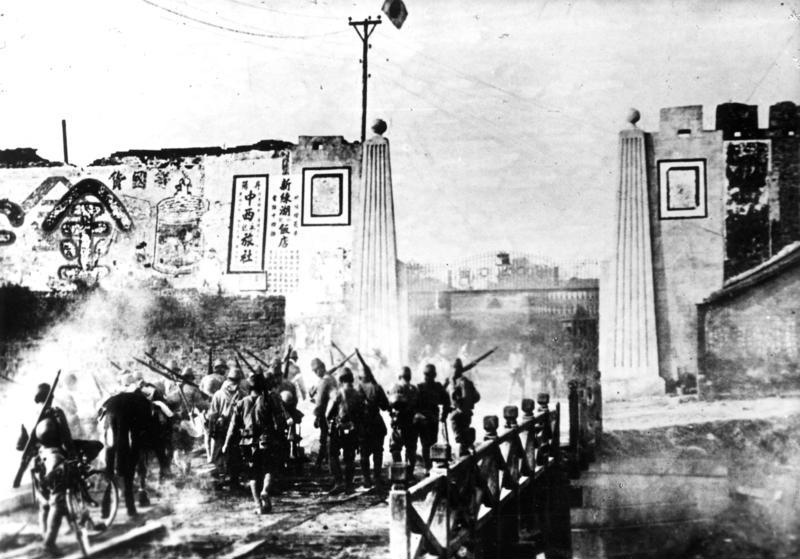
Japanese forces entering the city of Nanjing.
 As capital of the Republic of China, the city of Nanjing was captured by Japanese forces in 1937 as part of the early Pacific-Theater of WWII. In the months following the fall of Nanjing, and estimated 250,000 Chinese civilians were brutally killed in what is known as the Rape of Nanking. Today the massacre is still a touchy subject since some Japanese officials are denying the massacre ever took place. After the war, Nanjing was able to develop into the important industrial city it is today.

A Japanese soldier standing over the massacre victims
A park dedicated to the nation's martyrs.
A view looking over Nanjing and the 89 story Zifeng Tower, the 8th tallest skyscraper in the world.
One of the canals in downtown Nanjing. It is horribly polluted and (other than stinky tofu) was the worse thing I smelled in China.

A cleaner and more pleasant canal.

Wednesday, June 6, 2012

Of train travel through China;

I started my trip in Beijing, but I still needed to get to Shanghai; 800 miles to the South. I could have hoped on one of the trains that speed across the country at 185mph, but I wanted a slightly slower sleeper train so that I could hop on at night and wake up in my destination. I booked a ticket through my hostel for a bed on one of the first class sleeper cars and headed off to the train station.

The Beijing Railway Station.
When I got to the station I had no idea where to go but I had 30 extra minutes so I wasn't in any huge rush to get to my train. In the huge station I looked around for the waiting room for my train, but I couldn't find anything with my train number. After looking at my train ticket a few times I noticed that it said it was departing from the Beijing South Rail Station. That is when I got my first idea that something was wrong. I took out my city map and saw that about 8 subway stops from the Beijing Rail Station was the Beijing SOUTH Rail Station. I had that awful feeling where your stomach sinks and you know you've made a mistake. I had gone to the wrong station and my train, which I had already paid for, was going to be departing in less than 30 minutes.

I grabbed my bags and ran out of the station to the plaza outside. As I was sprinting across to the subway entrance a taxi driver noticed me and pulled me into his unmarked taxi. I was able to tell him about my mistake and show him my train ticket and departure time. We made the deal that I would pay him 200 RMB ($30 USD) if he got me there in time. In China, 200 RMB could buy you about 15 taxi rides so this driver really wanted to get me there on time. We sped off the the craziest and most terrifying taxi ride I've ever been on. We blasted through a few red lights and drove on the shoulder of the freeway all while the driver was honking at cars and flashing his lights so they would move out of the way.

We pull up to the rail station with about 4 minutes till my departure time. I run into the terminal. Throw my bags through the security x-ray and ask which way the gate from my train is. I get all my bags back on then sprint across the terminal to my train. I probably looked like I was competing on the Amazing Race. I made it to my train just in time. As soon as I boarded the train and found my cabin we started moving and pulled out of the station.

My train in the Nanjing Rail Station.
Now that I was finally on the train I could relax. I was exhausted, sweating, and jittery from my suspenseful and adrenaline filled taxi ride and sprint through the train station. I shared my sleeper cabin with 3 Chinese men who could speak a little bit of English. After talking with them for a little bit, they invited me to the party in the next cabin over with their coworkers. About eight of us crammed into this tiny sleeper cabin where they start offering me beers and food. My new Chinese friends were all young car designers on their way back to Shanghai from a car show. Some of the people in the group could speak English well so I told them all about my experience so far in China and how I came to China to perform with the marching band. They didn't know what a marching band was so I showed them some of the videos of the Husky Band field shows I had on my laptop. We had a great time swapping stories and sharing photos till late at night. Then they made sure I knew which stop to get off at in the morning and double checked the arrival time for me. What started as a miserable train experienced turned into a fun night thanks to these people. They were excited to have an American with them in their cabin and hear about my home, and I was just as thrilled to meet them and hear about life in China.

Our train cabin party at about 120 MPH.
The station I arrived at in Nanjing (just north of Shanghai)
The view of the city of Nanjing from the train station.

Tuesday, June 5, 2012

Of the Forbidden City;

A gate tower which separates some of the courtyards within the Forbidden City.
The major site to see in Beijing is the Forbidden City. It was built in 1406 as the emperor's palace. Today it is no longer forbidden to enter since it is now a huge heritage site and museum, but there are still some sections which are off limits for visitors. It is incredible how gigantic and elegant the city is. There are 9,999 rooms and it takes up 180 acres in the center of Beijing. It is surrounded by a moat and large walls with high gates and watchtowers.Within the Forbidden City are huge courtyards, gardens, narrow walkways, and large temples all decorated with traditional Chinese designs.

A view looking down at the Forbidden City and its moat and walls.

I spent several hours wandering around the Forbidden City. One of the first things that you notice are the huge crowds of people. The courtyards are filled with packs of tour groups and as you walk around the narrow corridors of the palace you feel like a cow being pushed through a stockyard. It was rare to find a nice quiet place to sit and appreciate the sites of the palace. I ended up taking a wrong turn through an unguarded door and entered a completely empty courtyard. It was amazing. There were no crowds, it was quiet, and I guess it was also forbidden. I poked my head into the Ancestral Temple and was spotted by several of the workers of the Forbidden City. They yelled a few things at me in Chinese and then escorted me back to the main palace grounds.
The Hall of Supreme Harmony, the largest of the buildings in the Forbidden City, was used for important imperial ceremonies during the Ming and Qing dynasties.

The whole Forbidden City is considered a museum because of all its history as the palace of the emperors, but within some of the buildings are museums (which you have to pay extra to visit) which showoff some of the valuable treasures of the Chinese empire. There were rooms of carved jade and other precious stone pieces and a huge collection of 19th century European clocks.

Every corner of the Forbidden City has little elements of Chinese design.

Friday, May 25, 2012

Of the food of Beijing;

My main source of food in China was street food. It is delicious, cheap, and, if you can make the right choices, it won't leave you sick after eating. My hostel in Beijing was in the Sanlitun district of the city. The area had some big shopping malls, but best of all there was a street a block from my hostel filled with line of small restaurants. After it gets dark, the small charcoal grills come out and the streets are filled with the smell of all sorts of grilled meats. My favorite spot was where there were two tiny shops with two little tables out front. One shop was a bakery with all sorts of breads filled with peppers and greens. The other shop usually had a big stack of steam trays cooking away. I stopped a number to times to get a snack to eat. For less than a dollar I could get a tray of steamed meat dumplings or a pile of tasty baked goods.


This was my favorite place. You can seen the steam-trays, but the bakery is so small you can't even see it tucked away behind the other businesses.
What I would get from the bakery. The top thing is a packet of braised greens. The bottom one is a bread with hot peppers and seasonings folded into the dough.
From the steam place you could get the humbow or the dumplings filled with the usual unidentifiable ground meat mixture you find all over China. Then you put a scoop of hot chili slurry in your little dish and mix it up with the vinegar so you have a nice spicy mix to dip your steamed goods into.
I also heard that the dried fruits in China are good. They were tasty, but I couldn't figure out what any of them were.
One of the foods Beijing is best known for is its Peking duck. There are restaurants all over the city that sell whole ducks cooked-up with super crispy skin. After watching the sun set from a temple complex with pagodas and pavilions representing the five tastes, two other travelers and I went to find a place to enjoy this Beijing delicacy.

Our server chopping the duck up in front of us.
You put the duck on a small thin pancake, add a few pieces of green onion, and add a sweet sauce before rolling it up and eating it.
We also ordered up some duck liver pate and something called Monkey Head Mushroom Soup. We were all disappointed when we didn't get a big monkey head floating in a bowl. It was just like any other soup.

Of the temples of Beijing;

One of the great things about Beijing is how old the city is. All around the city are palaces, temples, and gardens build by the past dynasties centuries ago.

The White Pagoda of Beihai Park.
The first temples I visited in China were in an area of parks and islands among the lakes running along the northwest side of the Forbidden City. On the peak of the hill on Jade Isle is the White Pagoda. Its bright white tower holds a reliquary of Buddhist scriptures and relics from monks. Jade Isle sits in a small lake surrounded by pagodas and gardens in Beihai Park.

A small stone bridge on Jade Isle in the middle of Beihai Lake.
The eaves of Chinese temples are always interesting.
A small pagoda in Beihai Park.
People would buy these little wooden medallions and write prayers on them before hanging them on the trees in the temple courtyard.
The White Pagoda of Beihai Park in the Beijing sunset.
Directly north of the Forbidden City is a big mound of earth rising from the ground covered with pavilions and pagodas known as Jingshan Park. This 45 meter high mound of dirt, which was built using manual labor and excess dirt of those dredging canals and motes six centuries ago, is now the highest point in the city of Beijing. Obviously not an easy talk to complete without the use of modern earthmovers and machinery. The hill has five peaks each with a structure which used to contain a copper Buddha statue representing each of the five tastes: sour, salty, bitter, acidic, and sweet. It is like a temple to food lovers. I guess I did go out to eat a big meal of Peking crispy duck after visiting the temples so there must be some sort of spiritual tie.
I don't think the No Climbing sign was too far away.
The main Pavilion in Jingshan Parks is on the highest point above the city and can be seen from all around the Forbidden City.
Me and the view from the pavilion looking over the Forbidden City and Tiananmen Square far in the distance.
The view towards the drum and bell towers north of Jingshan Park.
Me and the two Dutch travelers I spent the day traveling around Beijing with.

Thursday, May 24, 2012

Of the National Museum of China;


One of the larger buildings running along the side of Tiananmen Square is the National Museum of China. It is the most impressive museum I have ever seen. I never considered how nice a museum in a communist nation like China could be. Just the building it's in is incredible. It was built as one of the Ten Great Buildings of Beijing celebrating the first decade of the People's Republic of China. Inside it is filled some of the many treasures from the provinces all around China.

The view from the main entrance hall looking out
The inner-courtyard. It really amazes me how big this place is. There was also some intense security to get in.

The collections cover just about every period of Chinese history. The first room you see is filled with all the communist art. It was probably my favorite because I love nationalistic sculpture. Along the walls of the room are huge paintings depicting the struggles along the path to revolution and epic paintings of Mao's rise to greatness. Other galleries are filled with the most intricately carved natural resources of China. One room was devoted to gigantic carved jade pieces, another was sculptures made of ivory, while other rooms were full of works made of wood and precious stones. Another gallery covered Chinese history from the stone-age societies to the end of the Qing Dynasty.

Nationalistic paintings and statues.
A huge scene carved from many pieces of ivory.
A wooden relief carving.
Statue of Buddha
I'm not really sure what it is, but it is old.
In the 19th century Chinese loved European clocks and watches. This museum and the Forbidden City have collections of some of the most interesting and elegant clocks in China. This one is my favorite.